
I've spent a considerable amount of time over the past few years thinking about the kind of business I want to build.
And one of the more difficult realizations I've had is that there are businesses I'm perfectly capable of building that I have absolutely no desire to run.
I know how to create courses. I know how to build programs. I know how to facilitate workshops, manage communities, and work with larger groups of people.
I've done many of those things.
But when I started thinking about what my life would actually look like if I continued building in those directions, I realized that being capable of doing something wasn't a good enough reason to keep doing it.
I had to start asking myself a different set of questions.
How accessible did I want to be?
How many people did I want to work with?
What kind of work did I want to spend the majority of my time doing?
How much of my life was I willing to give to the business?
Those questions eventually became more important to me than figuring out how to grow.
Because before I could decide how to grow my business, I needed to decide what I was growing it into.
Your Personal Priorities Are Business Decisions
When Gary and I started working together, he shared two things he wanted to do more of: travel and spend time bonding with his kid.
Neither of those things required a particularly complicated vision statement.
But achieving them required us to examine how his business operated.
If he wanted to travel without constantly working, we needed to address how decisions were being made in his absence.
If he wanted uninterrupted time with his kid, we needed to understand why so many things required his immediate attention.
If he wanted the flexibility to choose when he worked, we needed to develop people who could carry responsibilities without his constant involvement.
His personal priorities were informing the work we needed to do inside the business.
I think many business owners approach this backward.
We establish revenue goals, create growth plans, develop services, and hire people. Then we try to figure out how to fit our personal lives around the business we've created.
We treat the life we want as something we'll earn once the business reaches a certain level of success.
But what if we considered those personal priorities at the beginning of the strategic planning process?
For example, I've decided that I want to take August off from coaching. I also want to take time away from the business between Thanksgiving and the beginning of the new year.
That decision affects considerably more than my calendar.
It influences when I enroll clients, how I structure coaching engagements, how I price my services, how I forecast revenue, and how I manage client expectations.
If I didn't account for those priorities when designing my business, taking that time off would eventually become a financial or operational inconvenience.
Instead, I'm designing the business to accommodate it.
That's a strategic decision.
And I think more business owners should give themselves permission to make those kinds of decisions.
Every Business Model Has Trade-Offs
One of the challenges I've experienced as a business owner is that I can see the potential in a lot of different business models.
I can see how a membership could generate recurring revenue. I can see how group coaching could allow me to serve more people. I can see how building a larger coaching firm could create opportunities that wouldn't otherwise be available to me.
But I've also learned to look beyond the potential revenue and consider what each of those models would require of me.
A membership needs a reason for people to remain members.
A group coaching program requires me to consider the needs and experiences of multiple people at once.
A larger coaching firm would eventually require me to spend more time managing the business and developing other coaches.
None of those things are inherently bad. But they each create a different experience of business ownership.
And that's something I think we should spend more time evaluating.
When we consider a new business opportunity, we tend to look at its potential.
How much money could it generate? How many people could we reach? Could it help us establish ourselves in the market?
Those are legitimate questions, but I'd also want to know:
What ongoing responsibilities would this create?
What would I have to give up to make it successful?
How would it change my role in the business?
Would I still want to run this part of the business three years from now?
That last question is particularly important to me.
I may enjoy creating something considerably more than I enjoy maintaining it. And if I'm not careful, I can build an entire business around things I enjoyed creating but have little interest in managing.
I've had to learn to distinguish between the excitement of building something and the reality of owning it.
Because once you've built it, someone has to run it.
What Are You Willing to Leave on the Table?
I think this is one of the more uncomfortable conversations in business ownership.
We talk a lot about recognizing opportunities, but considerably less about becoming comfortable with letting them pass.
Especially when they're good opportunities.
It's relatively easy to say no to something that isn't profitable or doesn't have much potential.
It's harder to say no to something that could work.
Over time, I've had to accept that building the kind of business I want may mean leaving certain revenue opportunities on the table.
I've become increasingly interested in building a boutique coaching practice. I enjoy deep conversations, working closely with people, and having enough time to think about the work I'm doing.
I don't necessarily want to serve hundreds of coaching clients.
But that preference has business implications.
If I want to serve fewer clients, I have to be intentional about pricing, positioning, client selection, and the value of the work I provide.
I can't simply reduce my client capacity and expect everything else to remain the same.
I have to build a business model that makes that choice financially sustainable.
And if I want to maintain that model, I also have to become comfortable declining opportunities that would gradually turn my practice into something else.
That's where having a clear vision for your business becomes particularly useful.
It helps you evaluate opportunities beyond their immediate financial potential.
A profitable opportunity can still take your business in a direction you don't want to go.
And sometimes the most strategic decision you can make is to leave a perfectly good opportunity alone.
Designing the Business Around the Outcome
Looking back at my work with Gary, I can see how much of our conversation was really about business design.
We spent time discussing his leadership, his decision-making, his relationship with his team, and his confidence in allowing other people to take ownership.
But those weren't isolated leadership development exercises.
They were changes that needed to happen for him to experience business ownership differently.
He didn't need to become a completely absent owner to have the freedom he wanted. He needed to create the conditions that would allow him to choose his level of involvement.
And I think that's an important distinction.
You may genuinely enjoy working with your clients. You may enjoy being involved in operations. You may even enjoy working more hours than another business owner would consider reasonable.
The question isn't whether you should be doing those things.
The question is whether you have a choice.
There's a difference between working directly with clients because you enjoy the work and working directly with every client because the business cannot generate revenue without you.
There's a difference between being involved in decisions because you find the work meaningful and being involved because nobody else has the authority to make them.
The work may look exactly the same from the outside.
But your experience of owning the business is very different.
That's why I believe founder freedom is ultimately about having choices. And creating those choices requires intentional decisions about how the business is structured, how it generates revenue, and how responsibilities are distributed.
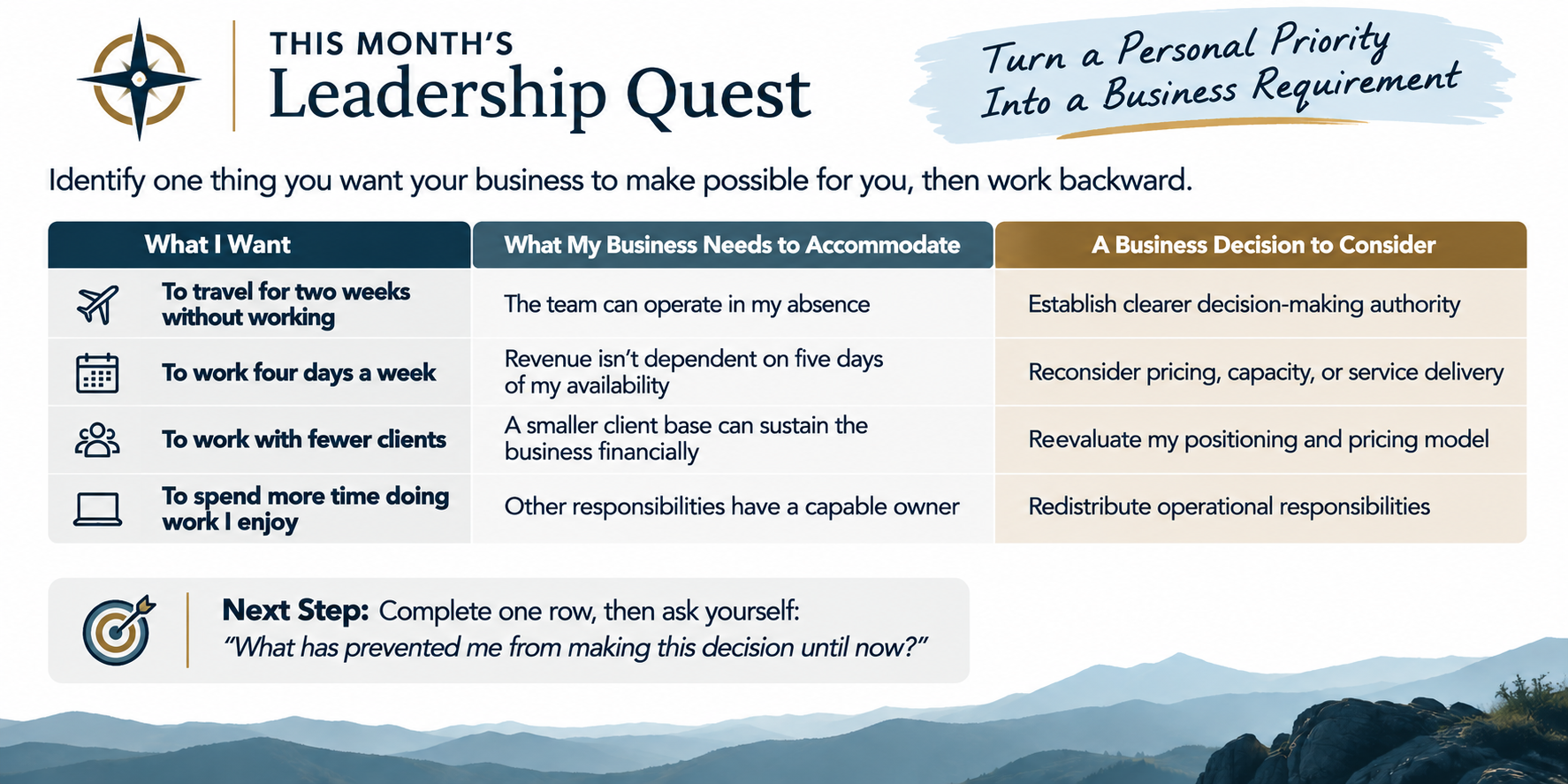
This Month's Leadership Quest
Turn a Personal Priority Into a Business Requirement
Set aside 15 minutes this week to identify one thing you want your business to make possible for you. It could be more time with your family, greater financial flexibility, fewer working hours, or more time doing work you genuinely enjoy.
Then, work backward by answering these three questions:
What do I want? Identify one personal or professional priority that matters to you.
What does my business need to accommodate? Consider what would need to be true about how your business operates for that priority to become a reality.
What business decision do I need to consider? Identify a potential change to your business model, pricing, operations, team structure, or responsibilities.
Use the examples below to guide your thinking.
Once you've identified a potential business decision, ask yourself:
What has prevented me from making this decision until now?
You may discover a financial constraint, an operational challenge, a gap in your team's capabilities, or a decision you've been reluctant to make.
Whatever you discover, you've identified something concrete to work on.
You don't need to redesign your entire business this month. Start with one priority and identify one meaningful change you can begin exploring over the next 30 days.
The purpose of this exercise is to begin treating your personal priorities as part of your business strategy rather than something you'll accommodate once the business becomes successful.
A Final Thought
I'm still designing the business I want.
I expect some of my preferences will change over time. The way I want to work today may not be the way I want to work five years from now.
But one thing I've become increasingly certain about is that I don't want to spend years building a successful business only to spend the next several years trying to free myself from it.
I'd rather consider what freedom looks like for me now and allow that understanding to influence the decisions I make along the way.
Perhaps that's a question worth including in your next strategic planning session:
What would I need to design differently if the life I wanted was a requirement of my business strategy rather than a reward for its success?
A Quiet Invitation
You don’t need to have it figured out. You don’t need to name it perfectly. Sometimes putting language to what you’re noticing is the first step toward understanding where you are as a leader.
From The Executive Desk exists for conversations like this. I create thinking rooms for leaders who already know how to execute.
If something in this letter—or in those questions—resonated, you’re welcome to share a thought or question with me.
Or, join the next Strategy Room.
Enjoyed the read? Sign up to get more like this.

P.S. Whenever you're ready...here are a few ways we can help YOU:
Write to CEO
Ongoing asynchronous coaching for founders who want a private space to think through decisions, challenges, and what comes next—without adding more meetings to their calendar.
TFC3 – Private 1:1 Coaching
Bespoke private coaching for founders navigating a leadership transition. We identify the priorities that matter most and spend 90 days working through the leadership, decisions, and changes your next chapter requires.
The Focused CEO Academy
Practical, self-directed learning for founders and small business owners who want to strengthen how they lead and build their businesses. Explore guided Quests, workshops, tools, and resources you can use at your own pace.
Not sure where to start? Send me a message here — I’ll help you figure out the best next step based on where you are in your business.