You Can’t Lead the Next Chapter from the Old Role

There comes a point in a growing business where effort is no longer the problem.
And yet, the leader still feels tired.
Not because they’re incapable.
Not because they’ve lost ambition.
But because they’re still leading from a role the business no longer requires.
Gary began to see this after we named the misalignment in his success.
He wasn’t confused about what he wanted anymore.
He was confused about who he was supposed to be inside the business now.
For years, he had been the builder.
The one making every decision.
The one approving everything.
The one clients relied on directly.
The one solving problems quickly and visibly.
That role had worked.
It had created momentum.
It had created stability.
It had created income.
But it had also quietly locked him into a version of leadership that made sense in year one — not in year five.
And that distinction matters.
The Role That Builds Is Not the Role That Leads
When you start a business, being involved in everything is necessary.
You:
Make the sales.
Deliver the work.
Solve the issues.
Put out the fires.
That intensity creates growth.
But growth changes the equation.
The business begins to need:
clarity more than hustle,
direction more than reaction,
discernment more than availability.
The problem is that most leaders don’t consciously update their role.
They just keep doing what worked before — only harder.
Gary was still answering questions he didn’t need to answer.
Still making decisions others were capable of making.
Still inserting himself into details that no longer required his expertise.
On paper, it looked responsible.
In reality, it was exhausting.
And more importantly, it was limiting.
Because every time he defaulted to being the doer, he postponed becoming the leader this stage required.
The Subtle Cost of Staying in the Old Role
No one applauds you for stepping back.
No one sends a congratulatory message when you stop being the hero in every situation.
In fact, stepping out of the old role can feel uncomfortable — even irresponsible.
Gary worried that if he wasn’t as present in every layer of the business, standards would slip.
He worried that people would think he was disengaged.
He worried that letting go would mean losing control.
These are normal fears.
But what we uncovered was this:
He wasn’t holding the business together anymore.
He was holding himself in place.
The business was ready for a different kind of leadership.
He just hadn’t allowed himself to practice it.
And here’s the quiet truth most founders discover eventually:
If you continue leading from the role that built the business, you will eventually become the bottleneck in the business.
Not because you lack skill.
But because your involvement hasn’t evolved.
When Identity and Role Get Tangled
Gary’s identity was deeply tied to being indispensable.
Being needed.
Being the one who could fix it.
Being the one clients requested.
Shifting out of that role felt like giving something up.
And in some ways, it was.
Growth often requires releasing parts of your identity that once felt foundational.
But releasing isn’t the same as erasing.
Gary didn’t need to stop being capable.
He needed to stop being central to everything.
He didn’t need to abandon responsibility.
He needed to redefine it.
Responsibility at this stage looked less like:
answering every question
reviewing every detail
personally ensuring every outcome
And more like:
setting direction
clarifying standards
deciding what truly required his involvement
That’s a different posture.
It’s quieter.
It’s less visible.
But it’s more powerful.
The Turning Point
The shift wasn’t dramatic.
There wasn’t a big announcement or a restructuring plan.
It started with smaller decisions.
He paused before answering questions that others could resolve.
He asked, “Does this actually require me?” before stepping in.
He began protecting thinking time the way he once protected client calls.
At first, it felt unnatural.
Like he was doing less.
But in reality, he was finally doing what this stage required.
Leading from the old role had kept him busy.
Leading from the new role required restraint.
And restraint, for high performers, is often harder than effort.
If You’re Feeling This Too
Many leaders sense this transition before they name it.
They feel:
stretched thin even though they’ve built support,
involved in too many decisions,
frustrated that growth hasn’t made things lighter.
They say things like:
“I thought scaling would make this easier.”
“I’m still in everything.”
“Why does it still feel like it depends on me?”
The answer is often not more strategy.
It’s role evolution.
The version of you that built this chapter may not be the version that needs to lead the next one.
That’s not a criticism.
It’s progression.
A Few Questions to Sit With
You don’t need to overhaul anything today.
Just notice.
Where are you still operating as if it’s year one?
What decisions are you making out of habit rather than necessity?
Where might your involvement be limiting someone else’s growth?
What part of your identity feels threatened by stepping back?
If your primary role shifted from “doing” to “deciding,” what would change?
If one of these questions feels uncomfortable, that’s not a red flag.
It’s information.
Transitions don’t always announce themselves loudly.
Sometimes they show up as fatigue.
Sometimes as frustration.
Sometimes as the quiet realization that the business has grown — and you need to grow with it.
A Quiet Invitation
If something in this letter resonated, you’re welcome to share a thought or question with me.
You don’t need to have it figured out. You don’t need to name it perfectly. Sometimes putting language to what you’re noticing is the first step toward understanding where you are as a leader.
From The Executive Desk exists for conversations like this.
I create thinking rooms for leaders who already know how to execute.
If something here sparked a thought for you, you’re welcome to share it here or send me a message.
Enjoyed the read? Sign up to get more like this.

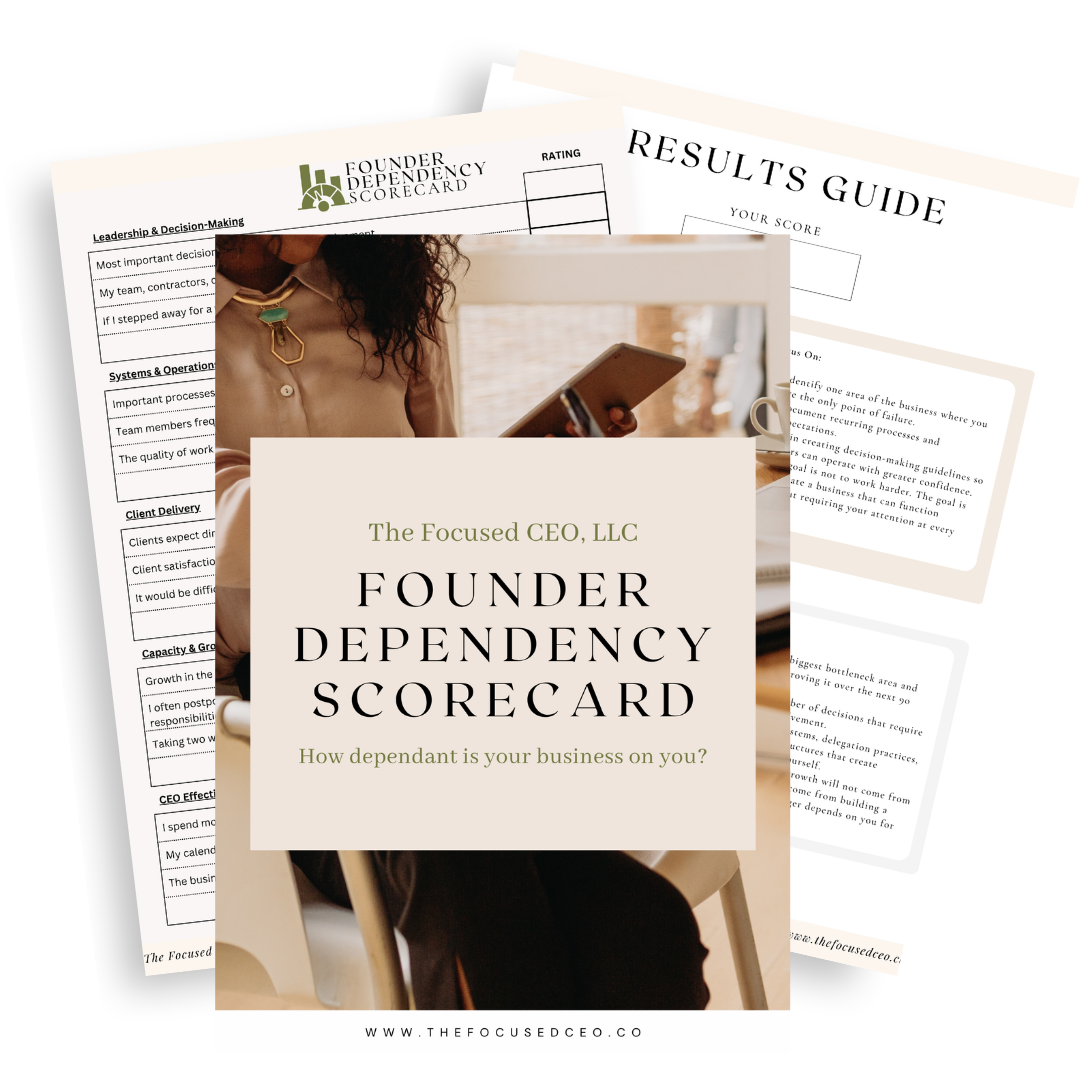

P.S. Whenever you're ready...here are a few ways we can help YOU:
Write to CEO
Ongoing asynchronous coaching for founders who want a private space to think through decisions, challenges, and what comes next—without adding more meetings to their calendar.
TFC3 – Private 1:1 Coaching
Bespoke private coaching for founders navigating a leadership transition. We identify the priorities that matter most and spend 90 days working through the leadership, decisions, and changes your next chapter requires.
The Focused CEO Academy
Practical, self-directed learning for founders and small business owners who want to strengthen how they lead and build their businesses. Explore guided Quests, workshops, tools, and resources you can use at your own pace.
Not sure where to start? Send me a message here — I’ll help you figure out the best next step based on where you are in your business.