The Difference Between Being Needed and Being Effective

I thought being needed was a badge of honor you wore to display your competency and can-do attitude.
Throughout most of my life, though, I've categorized it as both a blessing and a burden.
When people relied on me, it made me feel needed.
But over time, I felt like people needed me way too much—to the point where I wasn't resting enough and it was taking a toll on me physically and mentally.
I started resenting the people around me for asking me to do everything.
But here's the part I eventually had to acknowledge:
It was a system I had helped create.
With every "Call me if you need me."
Every "Let me know if you need anything."
Every time I stepped in before someone had the opportunity to figure something out for themselves.
So when Gary said to me, "I don't think they need me as much as I thought..." I understood immediately what he meant.
At first, it sounded like disappointment.
Like he was disappointed at the idea of no longer being needed—or relevant—in the business he created.
But I knew he was actually standing at the edge of creating freedom for himself.
The same freedom he was chasing when he started his business but had long forgotten.
The same freedom that had been hiding behind nearly every decision we'd talked about until now.
When Being Needed Becomes the Measure
Somewhere along the way, I—and many founders I've worked with—started equating being needed with being valuable.
The more people rely on us, the more important we feel.
The more questions that come our way, the more convinced we become that we're doing something right.
And there is some truth to that.
When you're building something from the ground up, you may bootstrap your way into eventually hiring a small team.
And that team will rely on you.
You're making the majority of the decisions.
You're solving the majority of the problems.
You're creating the culture before anyone else can help shape it.
In that season, being needed makes sense.
But businesses aren't supposed to remain in that season forever.
Neither are founders.
When you get to the point where Gary was, you begin to realize that you don't need people to need you in quite the same way anymore.
Gary's goal was to spend more time traveling and bonding with his kid.
He didn't want to have to be present all the time for his business to work. He felt as though he had already paid the "tuition" required to build a successful business.
But he had done the same thing I had done.
He had trained his people to become reliant on him.
And that's a hard cycle to break.
A Question That Changed the Conversation
My sessions with Gary taught me a lot about the ways founders and business owners can lose themselves in their businesses.
Decision-making.
Delegation.
Loss of vision.
Loss of purpose.
The belief that only you can do a "perfect" job.
The need to remain involved because involvement has become evidence that you're still valuable.
So I asked him:
"What would happen if someone else solved this for you?"
Every time someone came to Gary for an answer, it reinforced his place in the system he had created.
He was needed.
He was valuable.
He was important.
But what would happen if they didn't need him for that particular problem?
He sat with it for a moment.
"I guess...I guess it would be a good thing."
And that's when we started talking about the difference between being needed and being effective.
Being Needed vs. Being Effective
Being needed can look like:
You are at the center of everything. Questions, decisions, problems, and approvals eventually make their way back to you.
Your involvement becomes reassurance that you're still valuable to the business.
You step in quickly because solving the problem feels easier than allowing someone else to work through it.
You measure your contribution by how much the business still requires from you.
Other people become accustomed to looking to you before trusting their own judgment.
Being effective can look like:
You don't need to be at the center of every decision to influence the direction of the business.
You're more interested in the outcome than in being the person who personally creates it.
You give other people room to think, make decisions, solve problems, and occasionally get things wrong.
You can feel valuable without constant involvement.
Your leadership is reflected in what happens even when you're not in the room.
That last one was especially important for Gary.
Because the goal wasn't to make him irrelevant.
The goal was to change what his involvement looked like.
Redefining His Role
Once Gary understood the difference, we had to start redefining his involvement in the business.
What still required him?
What could someone else own?
Where was his involvement genuinely valuable?
And where was his involvement simply familiar?
This is when we started creating a framework for what freedom could actually look like for him.
I didn't have a name for it then. Honestly, I wasn't trying to create a framework at all.
Gary and I were simply trying to build a business that gave him more of the freedom he originally wanted when he became an entrepreneur.
But as we worked through decision-making, delegation, trust, leadership, vision, and his role in the business, a structure began to emerge.
Looking back, I can see it much more clearly now.
I'll share pieces of that framework as we move through the rest of Gary's lessons.
For now, this part started with a fairly simple admission:
Being needed and being effective are not the same thing.
And sometimes becoming a more effective leader means becoming a little less needed.
This Month's Leadership Quest
The next time someone comes to you with a problem they could potentially solve themselves, resist the urge to give them the answer.
Instead, ask:
"What do you think we should do?"
Then listen.
Notice what happens when you give someone else room to think before you step in.
At the end of the week, ask yourself:
Where did my absence from the solution make someone else more capable?
A Quiet Invitation
You don’t need to have it figured out. You don’t need to name it perfectly. Sometimes putting language to what you’re noticing is the first step toward understanding where you are as a leader.
From The Executive Desk exists for conversations like this. I create thinking rooms for leaders who already know how to execute.
If something in this letter—or in those questions—resonated, you’re welcome to share a thought or question with me.
Or, join the nextStrategy Room.
Enjoyed the read? Sign up to get more like this.

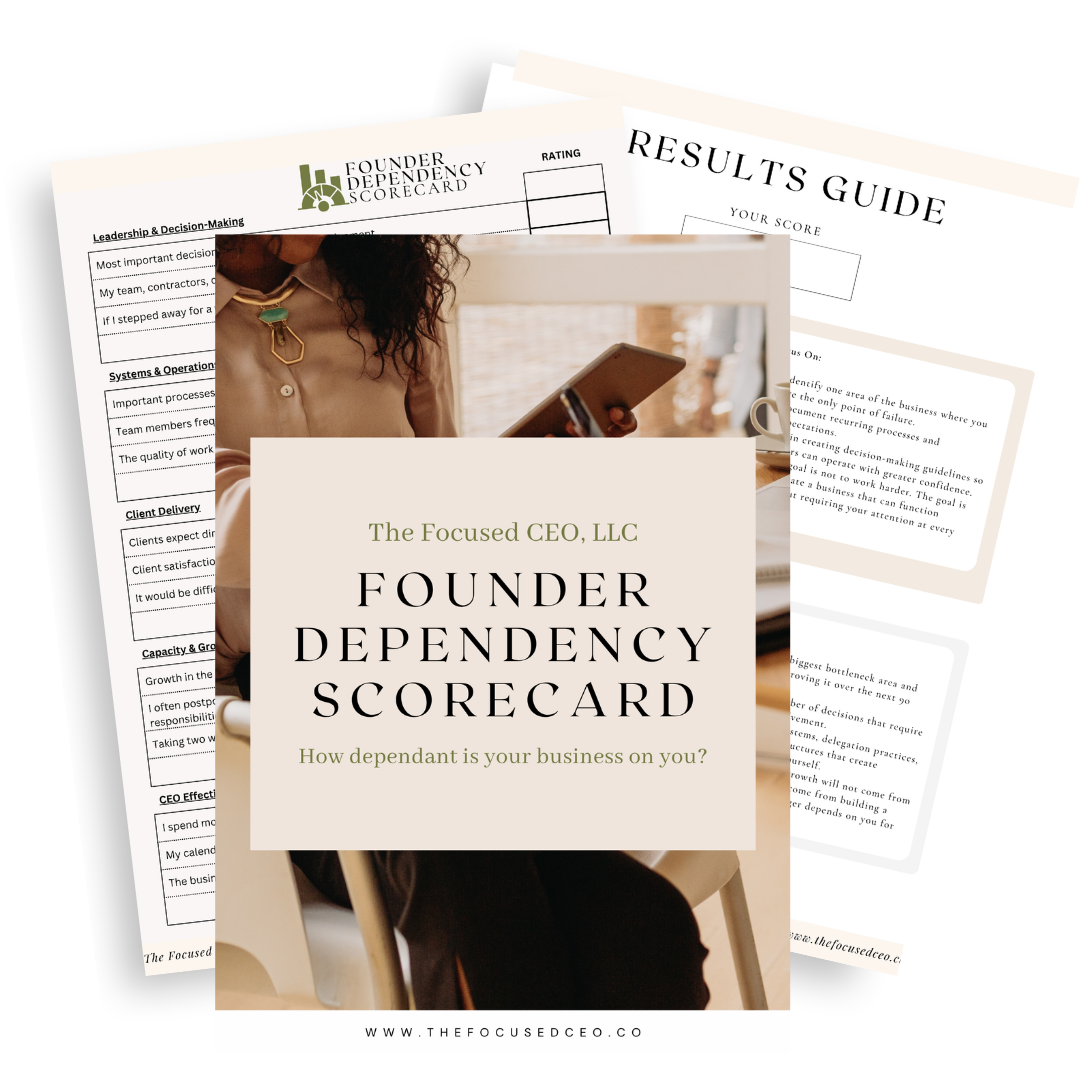

P.S. Whenever you're ready...here are a few ways we can help YOU:
Write to CEO
Ongoing asynchronous coaching for founders who want a private space to think through decisions, challenges, and what comes next—without adding more meetings to their calendar.
TFC3 – Private 1:1 Coaching
Bespoke private coaching for founders navigating a leadership transition. We identify the priorities that matter most and spend 90 days working through the leadership, decisions, and changes your next chapter requires.
The Focused CEO Academy
Practical, self-directed learning for founders and small business owners who want to strengthen how they lead and build their businesses. Explore guided Quests, workshops, tools, and resources you can use at your own pace.
Not sure where to start? Send me a message here — I’ll help you figure out the best next step based on where you are in your business.